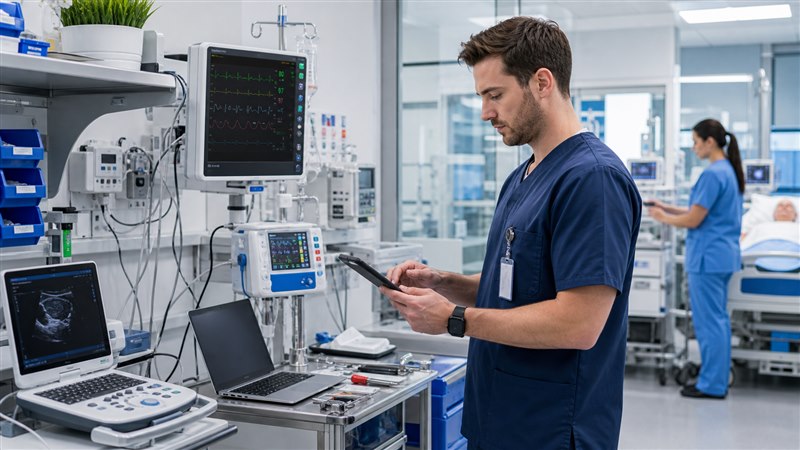
Hospital Equipment Maintenance: How to Extend the Life of Your Medical Devices in 2026
Hospital Equipment Maintenance: How to Extend the Life of Your Medical Devices in 2026

Table of Contents
- Why Maintenance Is a Procurement Issue, Not Just a Technical One
- The Real Cost of Neglected Medical Equipment
- Core Maintenance Practices by DepartmentICU and Patient Monitoring Equipment
- Imaging and Radiology Equipment
- Surgical and Operating Room Equipment
- Haemodialysis Machines
- Building a Preventive Maintenance Schedule
- How Equipment Quality Affects Maintenance Burden
- After-Sales Support: What to Demand from Your Supplier
- FAQs
- Conclusion
Why Maintenance Is a Procurement Issue, Not Just a Technical One
Price, delivery timelines, technical specifications - these dominate most procurement conversations. Maintenance planning rarely comes up until something fails.
That gap is expensive. The choices your team makes when sourcing equipment determine how maintainable that equipment will be across a 5, 10, or 15-year service life. Spare parts availability, technical documentation, local service support, manufacturer reputation - all of it traces back to who you bought from and how the purchase was structured.
Hospitals in developing markets face a particular version of this problem. Equipment arrives without adequate training. Spare parts are difficult to source locally. Manufacturer support is inconsistent. The result is premature failure and avoidable capital expenditure that strains already tight budgets.
This guide covers practical maintenance strategies by department, how to build a workable preventive schedule, and what to look for in a supplier before you sign a purchase order.
The Real Cost of Neglected Medical Equipment
Deferred maintenance is not a savings strategy. It is a deferred expense with interest.
When a ventilator fails mid-use, a dialysis machine delivers inaccurate filtration, or an X-ray unit produces degraded images, the consequences go well beyond repair costs. Patient safety is compromised. Clinical workflows are disrupted. Emergency replacement purchases happen under pressure - at higher cost and with less due diligence.
The compounding effect is real:
- Unplanned downtime pulls equipment out of rotation without warning, forcing clinical workarounds
- Reactive repairs typically cost 3 to 5 times more than scheduled preventive maintenance
- Shortened equipment lifespan accelerates capital replacement cycles
- Regulatory and accreditation risk grows when maintenance logs are absent or incomplete
A structured maintenance program protects more than the equipment. It protects the investment your facility made when it purchased that equipment in the first place.
Core Maintenance Practices by Department
ICU and Patient Monitoring Equipment
Patient monitors, ventilators, infusion pumps, and defibrillators run under continuous load. They need frequent, consistent attention.
Key practices:
- Daily: Verify alarm thresholds, battery charge levels, and cable integrity
- Weekly: Clean sensors and probe connectors; inspect display screens for dead pixels or calibration drift
- Monthly: Run available self-diagnostics; check ventilator flow sensors and expiratory valves
- Annually: Full biomedical calibration by a qualified technician; replace consumable components per manufacturer schedule
Brands like Mindray and Edan publish detailed maintenance protocols for their ICU product lines. If your equipment arrived with documentation your biomedical team cannot read, request translated manuals from your supplier before installation - not after.
Imaging and Radiology Equipment
X-ray units, ultrasound machines, and CT systems are among the most expensive assets in any facility. Their maintenance requirements are also the most specialized.
- Ultrasound probes: Inspect for cracks, delamination, and connector damage after every session; store probes vertically in designated holders
- X-ray and DR systems: Calibrate detectors quarterly; check collimator alignment and radiation output consistency; inspect high-voltage cables annually
- CT systems: Follow manufacturer-specified tube warm-up protocols daily; monitor scan quality metrics; schedule preventive tube replacement before failure rather than after
For facilities running Agfa, FUJI, or Neusoft imaging systems, manufacturer service agreements or authorized service partners are worth evaluating. These brands have established service networks that can meaningfully reduce response times when critical repairs are needed.
Surgical and Operating Room Equipment
OR equipment failures carry the highest clinical risk. Maintenance here is non-negotiable.
- Surgical lights: Check lumen output and color temperature monthly; replace bulbs or LED modules before they reach end-of-life ratings
- Electrosurgical units: Test output waveforms and return electrode monitoring circuits before each use; inspect handpieces and cables for insulation damage
- Anaesthesia machines: Daily pre-use checklists per manufacturer protocol; annual vaporizer servicing; breathing circuit integrity tests before every procedure
- Laminar flow systems: Replace HEPA filters per manufacturer schedule; validate airflow velocity and particle counts quarterly to maintain OR classification standards
Haemodialysis Machines
Dialysis equipment operates under demanding conditions with direct patient safety implications. Maintenance failures here can be life-threatening.
- Water treatment systems: Test water quality - conductivity, bacterial counts, endotoxin levels - at minimum weekly; replace RO membranes and filters on schedule
- Dialysis machines: Disinfect hydraulic circuits after every session; calibrate conductivity and temperature sensors monthly; inspect blood pump tubing segments for wear
- Concentrate proportioning: Verify bicarbonate and acid concentrate ratios regularly; check mixing accuracy with an independent conductivity meter
- Annual overhaul: Full hydraulic circuit inspection, pump head replacement, and software updates where applicable
Building a Preventive Maintenance Schedule

A maintenance schedule only works if it fits your team's actual capacity. Start here:
1. Inventory all equipment with service intervals Build a master list of every device, its manufacturer-recommended service intervals, and who owns each task.
2. Categorize by risk level Life-critical equipment - ventilators, defibrillators, dialysis machines, anaesthesia units - gets priority scheduling. Diagnostic support equipment follows.
3. Assign clear ownership Biomedical engineers handle calibration and technical servicing. Clinical staff handle daily operational checks. Define this clearly and put it in writing.
4. Account for parts lead times For facilities in Sub-Saharan Africa, Southeast Asia, or other regions where spare parts shipping takes 2 to 6 weeks, order consumables and wear parts well ahead of scheduled maintenance windows.
5. Keep service records Log every maintenance action: date, technician name, findings, parts replaced. This documentation supports warranty claims, accreditation audits, and resale value.
How Equipment Quality Affects Maintenance Burden
Not all equipment ages at the same rate. Build quality, component sourcing, and software architecture all influence how often a device needs attention and how straightforward it is to service.
Equipment from established manufacturers with documented service histories is easier to maintain over the long term. Spare parts move through official channels. Service manuals exist. Firmware updates address known issues rather than leaving them unresolved.
When sourcing from China, the manufacturer's reputation and export track record matter as much as the initial price. A device that costs 15% less but requires proprietary imported parts with a 10-week lead time is not cost-effective over a five-year horizon.
China Care Medical works with verified Chinese manufacturers including Mindray, Edan, Sonoscape, Neusoft, Agfa, FUJI, and Urit - brands that maintain established service documentation and international spare parts availability. For procurement teams in developing markets, that directly reduces the long-term maintenance burden.
After-Sales Support: What to Demand from Your Supplier

Before finalizing any equipment purchase, get answers to these questions in writing:
- Warranty terms: What is covered, for how long, and who pays for parts versus labor?
- Technical training: Will your biomedical and clinical staff receive hands-on training at installation?
- Service documentation: Are full service manuals provided in a language your team can actually use?
- Spare parts access: Where are parts stocked? What are typical lead times to your country?
- Remote support: Is there a technical helpline or remote diagnostic capability?
- Local service partners: Does the manufacturer or supplier have authorized service agents in your region?
A supplier that cannot answer these questions clearly before the sale will not answer them well after it. This matters even more for turnkey projects, where multiple equipment categories arrive simultaneously. Managing after-sales support across 10 or 15 device types through a single accountable supplier is far more practical than coordinating across a fragmented list of vendors.
FAQs
What is the most important maintenance practice for facilities with limited biomedical staff? Focus first on life-critical equipment: ventilators, defibrillators, dialysis machines, and anaesthesia units. Daily operational checks by trained clinical staff can catch early warning signs even without a full biomedical team on site. Document everything and escalate quickly when something looks off.
How often should medical equipment be calibrated? It depends on the device type and manufacturer specifications. Patient monitors and infusion pumps typically require annual calibration. Imaging systems may need quarterly checks on specific components. The manufacturer's published service schedule is your baseline - work from that.
What should I look for in a supplier to reduce long-term maintenance problems? Verified brand partnerships, available service documentation, clear spare parts supply chains, and evidence of after-sales support. Suppliers with a track record of completed installations in your region are better positioned to support you once the equipment is in use.
How do I manage spare parts for Chinese medical equipment in a remote location? Build a minimum stock of high-wear consumables at installation time. Work with your supplier to identify the 10 to 15 parts most likely to need replacement within the first two years, and negotiate to have those included in the initial order or held in a regional warehouse.
Does equipment from Chinese manufacturers come with adequate maintenance documentation? It varies significantly by manufacturer. Established brands like Mindray, Edan, and Sonoscape produce detailed technical and service documentation. When sourcing through a verified platform, confirm that service manuals, parts lists, and training materials are included in the delivery scope before you sign.
What is the difference between preventive and corrective maintenance? Preventive maintenance is scheduled work done to keep equipment functioning before a failure occurs. Corrective maintenance is reactive - done after something breaks. Preventive maintenance costs less per event and reduces unplanned downtime. Most hospital biomedical programs target at least a 70/30 split in favor of preventive work.
How does maintenance relate to procurement decisions? Directly. The supplier you choose, the brands you specify, and the after-sales terms you negotiate at purchase all determine how maintainable your equipment will be over its service life. Maintenance planning should start during procurement - not after delivery.
Conclusion
Extending the life of your medical devices is not primarily a technical challenge. It is a planning and procurement challenge. The right maintenance schedule, the right documentation, and the right supplier relationships are what separate equipment that performs reliably for a decade from equipment that becomes a liability within three years.
If you are sourcing or replacing equipment in 2026, build maintenance into your evaluation criteria from the start. Ask harder questions about after-sales support. Specify training as a delivery requirement. Choose manufacturers with established service infrastructure.
For procurement teams sourcing across multiple departments, working through a single verified platform reduces coordination complexity and improves accountability across the full equipment lifecycle. Learn more at chinacaremedical.com.
