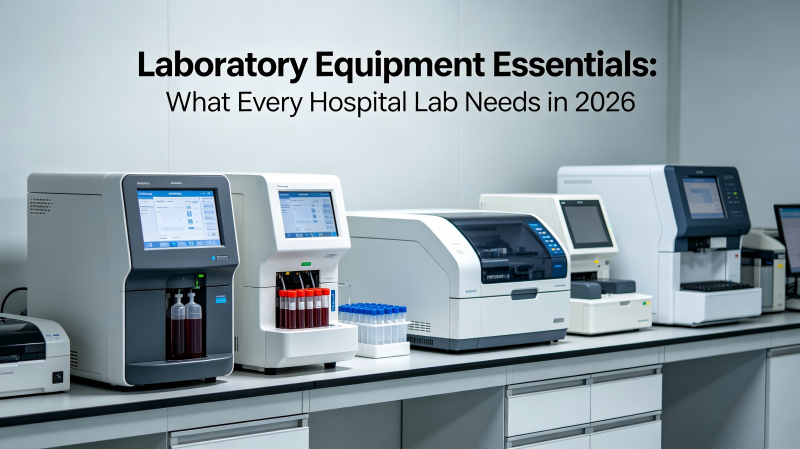
Laboratory Equipment Essentials: What Every Hospital Lab Needs in 2026
Laboratory Equipment Essentials: What Every Hospital Lab Needs in 2026
Table of Contents
- Why Laboratory Equipment Decisions Matter More Than Ever
- Core Categories of Hospital Laboratory Equipment
- Haematology and Blood Analysis
- Biochemistry and Clinical Chemistry
- Microbiology and Urinalysis
- Immunology and Rapid Diagnostics
- Sample Processing and Storage
- Matching Equipment to Lab Volume and Tier
- What to Verify Before You Buy
- Sourcing Hospital Laboratory Equipment from China
- FAQs
- Final Thoughts
Why Laboratory Equipment Decisions Matter More Than Ever
A lab running at capacity limits creates a bottleneck that ripples through every department. Delayed CBC results hold up surgical clearance. A malfunctioning biochemistry analyser stalls nephrology rounds. And in 2026, procurement teams are navigating all of this under tighter budgets, faster patient throughput expectations, and growing pressure to source equipment that can actually be serviced without flying in a technician from another continent.
Getting the selection right from the start reduces downtime, protects your budget, and directly affects patient outcomes. This guide covers the essential equipment categories, how to match them to your facility's workload, and what to confirm before committing to a supplier.
Core Categories of Hospital Laboratory Equipment
Haematology and Blood Analysis
The haematology analyser is typically the highest-volume instrument in any hospital lab — processing CBCs, differentials, and reticulocyte counts day in and day out. For most district hospitals and mid-size facilities, a 5-part differential analyser handles daily demand without issue. Larger referral hospitals often need multi-channel models with throughput exceeding 100 samples per hour.
Key specs to evaluate:
- Parameter count (18-part vs. 5-part differential)
- Throughput in samples per hour
- Reagent compatibility and local availability
- Closed-tube sampling to reduce biohazard exposure
Mindray and Urit are well-established in this category, with instruments deployed across hospital networks in Sub-Saharan Africa, Southeast Asia, and the Middle East.
Biochemistry and Clinical Chemistry
Biochemistry analysers cover liver function, renal function, lipids, glucose, and electrolytes. For a busy general hospital, a fully automated chemistry analyser with 200+ tests per hour is a practical baseline. Semi-automated options work for lower-volume settings where capital budget is a constraint.
Worth considering:
- Open vs. closed reagent systems — open systems give your team more flexibility on reagent sourcing
- Onboard test menu size
- ISE module for electrolyte testing
- Calibration frequency and maintenance cycle
Procurement teams in developing markets frequently prioritise open reagent systems specifically to avoid dependency on a single supplier, particularly in regions where import timelines are unpredictable.
Microbiology and Urinalysis
Urinalysis systems range from basic dipstick readers to fully automated sediment analysers. A mid-range system that handles both chemistry and sediment in a single pass meaningfully reduces manual workload for lab staff.
For microbiology, a functional baseline includes:
- A Class II biosafety cabinet for culture work
- A temperature-controlled incubator
- A microscope with oil immersion capability
- Basic staining equipment for Gram staining
Automated culture systems and MALDI-TOF identification are valuable additions, but they're typically tertiary-level investments rather than essentials for district or general hospitals.
Immunology and Rapid Diagnostics
Immunoassay analysers run thyroid panels (TSH, T3, T4), tumour markers, hepatitis serology, and hormone testing. Chemiluminescence-based platforms offer meaningfully better sensitivity than older ELISA systems and are now available at price points that work for mid-tier hospitals.
For rapid diagnostic testing, standardising on a single automated RDT reader platform — where possible — reduces inter-reader variability and supports quality control requirements for accreditation. Manual visual interpretation introduces inconsistency that becomes harder to manage at scale.
Sample Processing and Storage
These categories tend to get underweighted in equipment planning, but they're operationally critical:
- Centrifuges: Benchtop refrigerated centrifuges for serum separation; microcentrifuges for molecular work
- Refrigerators and freezers: Dedicated medical-grade units at 2–8°C for reagents, and -20°C or -80°C for sample archiving
- Water purification: Type I or Type II purified water systems for reagent preparation
- Label printers and LIS integration: Barcode-based sample tracking cuts transcription errors and supports lab information system connectivity
Matching Equipment to Lab Volume and Tier
The right configuration depends heavily on your facility's daily sample load. A high-throughput analyser in a low-volume setting wastes capital and increases reagent waste. Under-specifying for a busy referral lab creates queues and puts unnecessary pressure on staff.
Facility Type | Recommended Analyser Tier | Daily Sample Volume (est.) |
Primary health centre | Semi-automated, single-function | Under 50 |
District hospital | Automated, mid-range | 50–200 |
General referral hospital | Fully automated, multi-module | 200–600 |
Tertiary/teaching hospital | High-throughput, integrated LIS | 600+ |
Budget allocation should follow the same logic. Match the instrument tier to the actual workload, not to an aspirational throughput figure.
What to Verify Before You Buy
Before committing to an order, procurement teams sourcing laboratory equipment internationally should confirm the following:
Regulatory certification
- CE marking or FDA clearance are the most widely recognised benchmarks
- ISO 13485 certification for the manufacturer's quality management system
- In-country registration requirements vary — confirm with your local health authority before finalising specs
Reagent and consumable supply chain
- Are reagents available through a local distributor, or does everything need to be imported?
- What is the realistic lead time for restocking?
- Are consumables proprietary, or compatible with third-party alternatives?
After-sales support
- Is there a trained service engineer accessible in your region?
- Does the supplier offer remote diagnostics or on-site calibration?
- What does the warranty actually cover, and for how long?
Installation and training
- Will the supplier commission the equipment on-site?
- Is operator training included, and in what language?
These aren't formalities. They determine whether your lab runs reliably two years after installation or whether you're managing avoidable downtime.
Sourcing Hospital Laboratory Equipment from China
China is the world's largest producer of medical diagnostic equipment, and the quality gap between Chinese manufacturers and Western brands has narrowed considerably over the past decade. Mindray, Urit, and Edan now hold CE certifications and are deployed in hospitals across Europe, Africa, and Asia.
The challenge for international procurement teams isn't the equipment itself — it's finding a sourcing partner who can verify product specifications, manage logistics, handle customs documentation, and remain accountable after the shipment arrives.
China Care Medical organises laboratory equipment alongside 25+ other medical departments in a single platform, with verified partnerships with brands including Mindray, Urit, and Edan. Rather than cold-contacting individual factories, your procurement team can browse by department, request formal quotations, and reference a project track record spanning 100+ countries.
For procurement cycles where you need documented supplier credentials — not just a product listing from a generic marketplace — that structure matters.
FAQs
What is the most important piece of equipment for a hospital laboratory?
It depends on your facility's case mix, but a haematology analyser and a biochemistry analyser together cover the majority of routine diagnostics in most general hospitals. These two instruments are the logical starting point when equipping a new lab.
How do I verify the quality of laboratory equipment from Chinese manufacturers?
Look for CE marking, ISO 13485 certification, and FDA clearance where applicable. Ask for reference sites in your region and request documentation on the manufacturer's quality management system. Working through a sourcing partner with verified brand relationships significantly reduces the risk of receiving uncertified or misrepresented products.
What is the difference between open and closed reagent systems?
An open system allows you to source reagents from multiple suppliers, giving your team flexibility on pricing and availability. A closed system requires proprietary reagents from the original manufacturer. Open systems generally reduce long-term operating costs but require more active calibration management.
How much does it cost to equip a hospital laboratory from scratch?
A functional basic lab for a district hospital can be equipped for $20,000–$80,000 depending on analyser tier and module count. A fully automated referral-level lab covering haematology, chemistry, immunoassay, and microbiology can run $150,000–$500,000+. Figures vary based on brand, throughput, and whether service contracts are included.
What after-sales support should I expect from a medical equipment supplier?
At minimum: a 12–24 month warranty, access to a trained service engineer in your region, spare parts and consumable availability, and operator training at installation. Remote diagnostics support is increasingly standard on modern analysers and reduces the need for costly on-site visits.
Can I source laboratory equipment and other hospital departments from the same supplier?
Yes — and for multi-department projects, it's often the more efficient approach. A single sourcing partner covering laboratory, radiology, ICU, and surgical departments simplifies logistics, customs documentation, and vendor management considerably. Department-organised platforms make this practical without requiring your team to manage multiple supplier relationships simultaneously.
What certifications should a laboratory equipment manufacturer hold?
ISO 13485 for quality management, CE marking for European market compliance, and FDA 510(k) clearance for the US market are the most widely recognised. For procurement teams in Africa, the Middle East, and Southeast Asia, CE marking is typically the accepted benchmark, though some countries have additional local registration requirements worth confirming in advance.
Final Thoughts
The analysers you select today will shape your lab's diagnostic capacity, operating costs, and staff workload for the next five to ten years. Prioritise verified certifications, realistic throughput matching, and a supplier with a credible post-installation support model — not just a competitive unit price.
If your procurement cycle covers laboratory equipment alongside other departments, China Care Medical offers a structured way to source across multiple categories from verified manufacturers, with a project track record that spans district hospitals through to full turnkey facility setups.
Related articles