China Medical Equipment Supplier vs Alibaba: Which Is Right for Your Hospital in 2026?
China Medical Equipment Supplier vs Alibaba: Which Is Right for Your Hospital in 2026?China Medical Equipment Supplier vs Alibaba: Which Is Right for Your Hospital in 2026?
Table of Contents

- How Alibaba Works for Medical Equipment Sourcing
- What Alibaba Gets Right
- Where Alibaba Falls Short for Hospitals
- How Dedicated China Medical Equipment Suppliers Work
- Verified Brands, Not Random Factories
- Department-Organized Procurement
- Turnkey Project Delivery
Why This Comparison Matters for Hospital Procurement
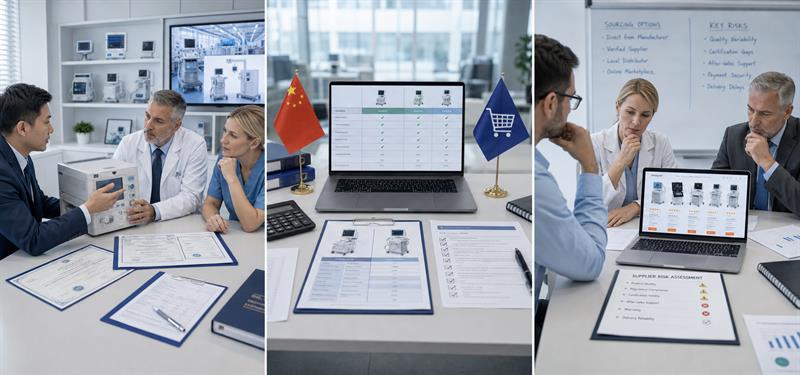
When sourcing medical equipment from China, most procurement teams encounter the same two options early on: Alibaba and dedicated medical equipment suppliers. Both give you access to Chinese manufacturers. But the way they operate is fundamentally different 鈥?and picking the wrong one can mean wasted budget, delayed timelines, and real clinical risk.
This guide lays out both options honestly, so your team can make the right call for your facility and procurement cycle.
How Alibaba Works for Medical Equipment Sourcing
Alibaba is a general-purpose B2B marketplace. It aggregates products from hundreds of thousands of manufacturers across virtually every industry 鈥?medical devices included.
What Alibaba Gets Right
- Broad selection. Almost any product category is represented, from surgical consumables to CT scanners.
- Indicative pricing. Many listings include price ranges, which can help with early-stage budget planning.
- Direct factory contact. For high-volume commodity purchases, some procurement teams prefer going straight to the source.
Where Alibaba Falls Short for Hospitals
For hospital procurement, the gaps are significant.
Supplier verification is inconsistent. Alibaba's "Gold Supplier" and "Verified Supplier" labels reflect a paid membership or a third-party audit 鈥?not confirmation that a factory is qualified to produce clinical-grade equipment. Due diligence falls entirely on your team.
No clinical structure. Alibaba organizes by generic product categories. If you're equipping a haemodialysis center or an ICU, you're sorting through thousands of unrelated listings with no medical context to guide you.
Specification accuracy varies. Listings are written by sales teams, not clinical engineers. Certifications, compliance claims, and technical specs all need independent verification before you commit to a purchase order.
After-sales support is factory-dependent. Once a transaction closes, warranty enforcement, spare parts availability, and technical training are entirely up to the individual manufacturer. There's no platform-level accountability.
Logistics are your responsibility. Alibaba facilitates introductions, not delivery. Shipping, import documentation, customs clearance, and installation coordination all land on your team.
For a single low-value consumable, these limitations may be workable. For a multi-department procurement cycle or a full facility setup, they represent serious operational exposure.
How Dedicated China Medical Equipment Suppliers Work

Dedicated medical equipment suppliers operate in a different model entirely. Rather than listing products across every industry, they specialize in healthcare procurement from inquiry through to installation.
Verified Brands, Not Random Factories
A credible dedicated supplier works with established Chinese medical brands that carry recognized international certifications. China Care Medical, for example, has verified partnerships with Mindray, Edan, Sonoscape, Neusoft, Agfa, FUJI, and Urit 鈥?names that appear in hospitals worldwide, not anonymous OEM factories.
That distinction carries real weight when your procurement committee or ministry of health needs to approve a purchase. Specifying a Mindray patient monitor or a Sonoscape ultrasound system is a very different conversation from citing an unknown Alibaba listing.
Department-Organized Procurement
Dedicated suppliers structure their catalogs around how hospitals actually function. China Care Medical covers 25+ medical departments 鈥?radiology, ICU, operating rooms, haemodialysis, laboratory, and more 鈥?so your procurement officer can browse by department rather than running disconnected keyword searches across multiple vendor sites.
This makes it considerably easier to identify what a specific ward or facility expansion requires, without cross-referencing half a dozen sources.
Turnkey Project Delivery
This is the sharpest differentiator. A dedicated medical equipment supplier can manage a project from equipment selection through to installation and staff training. Alibaba cannot.
China Care Medical has completed turnkey installations including laminar flow operating rooms and haemodialysis centers, with documented project portfolios available for review. For procurement teams managing a new facility build or a major department upgrade, that end-to-end capability removes a significant coordination burden.
Projects in the $20,000 to $500,000+ range require formal quotations, compliance documentation, logistics coordination, and post-installation support. A dedicated supplier is built to handle all of it. A general marketplace is not.
Side-by-Side Comparison
Factor | Alibaba | Dedicated Medical Supplier |
Supplier verification | Inconsistent, largely self-reported | Verified brand partnerships |
Medical department structure | No | Yes (25+ departments) |
Clinical specification accuracy | Variable | Managed by medical trade specialists |
Turnkey project capability | No | Yes (OR, dialysis, full facility) |
After-sales support | Factory-dependent | Platform-managed |
Logistics and customs | Buyer's responsibility | Coordinated by supplier |
Formal quotation process | Limited | Standard workflow |
Countries served | Global marketplace | 100+ countries with active delivery |
Best for | Commodity items, low-value orders | Hospital-grade equipment, facility projects |
Which Option Fits Your Procurement Situation
Consider Alibaba if:
- You're purchasing low-value consumables or accessories in bulk
- Your sourcing team has the capacity to independently verify suppliers, specifications, and certifications
- You're comfortable managing logistics, customs, and after-sales on your own
- The purchase doesn't require clinical compliance documentation
Consider a dedicated medical equipment supplier if:
- You're equipping a department, ward, or full facility
- Your procurement cycle requires formal quotations and documented specifications
- You need verified brands your administration or ministry of health can approve
- You want a single point of contact for logistics, installation, and training
- You're operating in a market where import compliance requires specialist handling
For most hospital procurement teams sourcing clinical-grade equipment from China, the dedicated supplier route is the lower-risk, more efficient path. The time saved on supplier verification, specification validation, and logistics coordination typically outweighs any price advantage from sourcing directly through Alibaba.
If your team is currently evaluating Chinese medical equipment suppliers, chinacaremedical.com covers 25+ medical departments with verified brand partnerships and a documented project portfolio spanning 100+ countries. Submit an inquiry and you'll receive a response within 24 hours.
FAQs
Is it safe to buy medical equipment from China? Yes 鈥?provided you source from verified suppliers working with certified manufacturers. Brands like Mindray, Sonoscape, and Edan supply hospitals globally and hold internationally recognized certifications. The risk comes from unverified factories, not from China as a sourcing market.
What's the difference between Alibaba and a dedicated medical equipment supplier? Alibaba is a general marketplace where you find and contact factories directly. A dedicated medical equipment supplier manages the sourcing relationship, verifies product quality, coordinates logistics, and provides after-sales support and turnkey project delivery. For hospital procurement, that structure reduces risk considerably.
Can I get a formal quotation from a China medical equipment supplier? Yes. Dedicated suppliers like China Care Medical operate on an inquiry-based model 鈥?your team submits requirements and receives a formal quotation covering specifications, pricing, and delivery terms. This is standard practice for B2B medical procurement.
How do I verify that a Chinese medical equipment supplier is legitimate? Look for documented partnerships with recognized manufacturers, a real project portfolio with completed installations, and a track record of deliveries across multiple countries. Be cautious of any supplier that can't provide certifications or reference projects on request.
What types of projects can a dedicated China medical equipment supplier handle? Beyond individual equipment sales, established suppliers can deliver turnkey setups for operating rooms, haemodialysis centers, ICUs, radiology departments, and complete hospital facilities 鈥?including equipment supply, logistics, installation, and technical training.
How long does it take to receive medical equipment from China? Lead times depend on equipment type, order volume, and destination. Most orders take 4 to 12 weeks from confirmed purchase order to delivery, depending on shipping method and customs processing in the receiving country.
What brands are available through dedicated China medical equipment suppliers? Reputable suppliers work with established Chinese medical brands. China Care Medical's verified partnerships include Mindray, Edan, Sonoscape, Neusoft, Agfa, FUJI, and Urit 鈥?covering imaging, diagnostics, patient monitoring, and more.
Final Recommendation
Alibaba has a place in procurement, but it isn't designed for hospital-grade medical equipment sourcing. The verification gaps, absence of clinical structure, and lack of project delivery capability make it a poor fit for most hospital procurement cycles.
A dedicated China medical equipment supplier gives your team verified brands, department-organized browsing, formal quotation workflows, and full turnkey delivery where needed. For procurement decisions in the $20,000 to $500,000+ range, that structure is worth considerably more than open-marketplace access.
Submit an inquiry and learn more at chinacaremedical.com.
Related articles