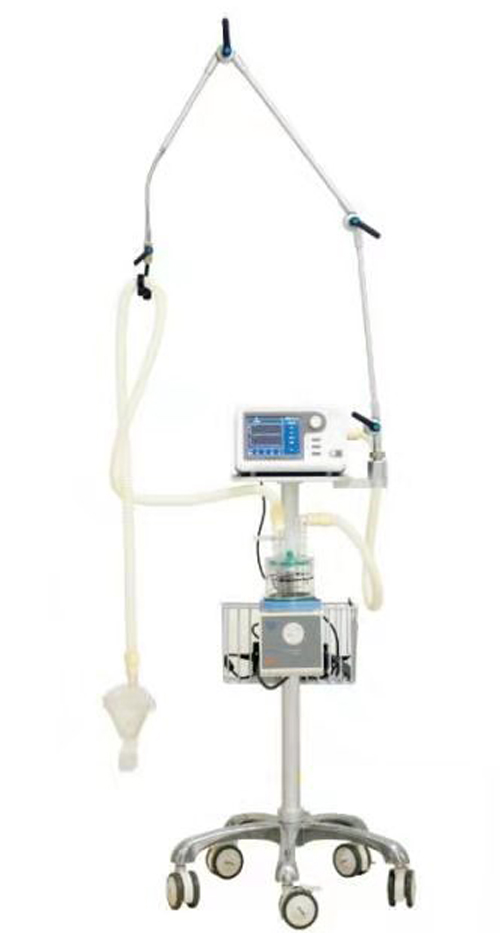
Product info
- Product name:Non-Invasive Ventilator (NIV / BiPAP System) – Hospital Respiratory Support Machine for ICU & Emergency Use
- Product code:CCV30F
Packaging Specifications
- Outer Packaging Size:0.35 × 0.24 × 0.2 m
- Gross Weight:3.4 kg
- Net Weight:0 kg
- Volume:0.02
Description
🫁 Non-Invasive Ventilator (NIV / BiPAP System)
The non-invasive ventilator (NIV) is a medical respiratory support system that provides assisted ventilation without the need for endotracheal intubation.
It delivers pressurized airflow through a face mask, helping patients improve oxygenation and reduce the work of breathing while maintaining spontaneous respiration.
It is widely used in ICU, emergency departments, respiratory wards, and sleep disorder treatment centers.
🧠 What is Non-Invasive Ventilation (NIV)?
Non-invasive ventilation refers to ventilatory support delivered through an external mask instead of an invasive airway tube.
It works by applying positive airway pressure to assist breathing and improve gas exchange.
Common forms include:
CPAP (Continuous Positive Airway Pressure)
BiPAP / Bilevel Positive Airway Pressure
Pressure Support Ventilation (PSV)
⭐ Key Advantages
🫁 Avoids Intubation
Provides respiratory support without invasive tracheal intubation, reducing complications such as:
Ventilator-associated pneumonia (VAP)
Airway trauma
Sedation-related risks
⚡ Improves Oxygenation & Ventilation
Supports both oxygen intake and CO₂ removal by adjusting inspiratory and expiratory pressures.
🧠 Reduces Work of Breathing
Helps patients breathe more easily by reducing respiratory muscle fatigue.
🏥 Widely Used in ICU & Emergency Care
Suitable for acute and chronic respiratory support situations.
🔄 Adjustable Ventilation Modes
Typically supports:
CPAP mode (oxygenation support)
BiPAP mode (ventilation + oxygenation)
Spontaneous / timed modes
🏥 Clinical Applications
Non-invasive ventilators are widely used in:
🫁 Respiratory Diseases
COPD exacerbation
Type II respiratory failure
Pneumonia-related hypoxia
Pulmonary edema (cardiogenic)
🧠 Critical Care / ICU
Acute respiratory distress (early stage)
Post-extubation respiratory support
Weaning from invasive ventilation
😴 Sleep & Chronic Conditions
Obstructive sleep apnea (OSA)
Chronic hypoventilation syndromes
🚑 Emergency Medicine
Acute dyspnea
Emergency oxygenation support
Pre-intubation stabilization
⚙️ Technical Overview
| Item | Specification |
|---|---|
| Device Type | Non-invasive ventilator (NIV / BiPAP system) |
| Ventilation Mode | CPAP / BiPAP / PSV |
| Interface | Face mask (oronasal / nasal) |
| Pressure Range | Adjustable inspiratory & expiratory pressure |
| Operation Mode | Spontaneous / timed / assist-control |
| Monitoring | SpO₂ / pressure / respiratory rate (model dependent) |
| Humidification | Optional integrated humidifier |
| Alarm System | Pressure / leakage / disconnection alarms |
🧠 How It Works
The system delivers pressurized air through a sealed mask:
Inspiratory pressure (IPAP) helps inhale
Expiratory pressure (EPAP) keeps alveoli open
Continuous airflow improves gas exchange
This reduces respiratory effort while maintaining spontaneous breathing.
🏥 Why Hospitals Use NIV Instead of Intubation
Compared with invasive mechanical ventilation, NIV offers:
Lower infection risk
No airway tube required
Reduced sedation needs
Easier patient management
Faster recovery in selected patients
It is often used as a first-line respiratory support before intubation.
👨⚕️ Recommended Users
ICU departments
Emergency departments
Respiratory wards
Pulmonology clinics
Sleep disorder centers
Medical distributors
no comments