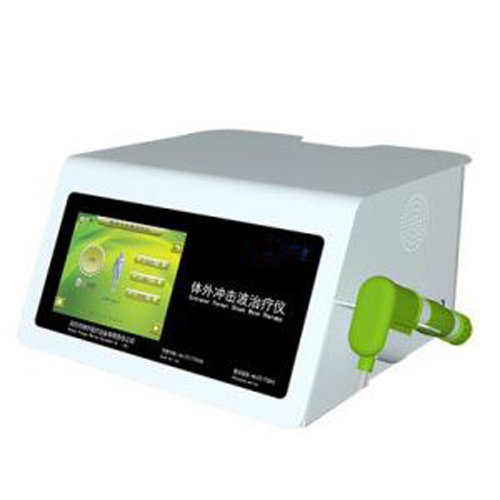
Product info
- Product name:Extracorporeal Shock Wave Therapy Device
- Product code:CCRMED
Packaging Specifications
- Outer Packaging Size:0 × 0 × 0 m
- Gross Weight:0 kg
- Net Weight:0 kg
- Volume:0
Description
Treatment principle
Extracorporeal shock wave is a mechanical pulse pressure wave that is conducted through a medium of physical mechanism, that converts a pneumatically generated pulse sound wave into a precise ballistic shock wave. By positioning and movement of handpiece, it has a great therapeutic effect on the pain occurring in human tissues.
Specifications
| Item | Details |
|---|---|
| Model | |
| Power supply | AC 220V±22V 50Hz |
| Rated input power | 550VA |
| Working frequency | 1~22Hz, stepping 0.5Hz |
| Impact frequency | 100~9900 times, stepping 100 times |
| Impact pressure | 1-5bar, stepping 0.1bar |
| Size | 466mm*400mm*220mm |
| Time | 1~99min |
| Energy density | ≤0.63mJ/mm² |
| Display | 8-inch touch LCD screen |
| Operating noise | ≤60dB(A) |
| Prescriptions | 200 built-in |
| Treatment pistols | 6 types: Standard, frequency conversion, deep, focused, acupoint |
Advantage
Shock wave is a noninvasive therapeutic technique that produces fast, effective curative effects. It is a safe, reliable, painless physical therapy. Compared to traditional acupuncture, needle knife, minimally invasive and other invasive treatment, shock wave therapy is not only a noninvasive treatment, but also with its fine dose adjustment range, the diversity of treatment methods, the unlimited treatment location, that become the fastest, safe and effective pain management technology for physical therapy. Therefore, it is called as the best solution of pain.
Indications
- Chronic injury of limb soft tissue: Shoulder: frozen shoulder, biceps long tendonitis, subacromial bursitis, calcified post ganglionitis; Elbow: humeral epicondylitis; Wrist: tenosynovitis, finger arthritis; Knee: patellar tendinitis, knee arthritis; Foot: plantar fasciitis, Achilles tendon, Achilles tendon shortening; Neck and waist: neck and shoulder muscle pain, caudal pain, lumbar transverse process syndrome.
- Bone tissue disease: Nonunion, delayed union and non-union fracture, adult femoral ischemic necrosis.
- Other application: Difficult wound healing, such as diabetes, bedsores, burns and other hard-to-heal wounds.
Biological effects
- Repair and reconstruction to tissue damage
- Release effect to tissue adhesions
- Expanding blood vessels and vascular regeneration
- Analgesic and nerve endings closed
- High-density tissue cleavage effect
- Inflammation and infection control
no comments