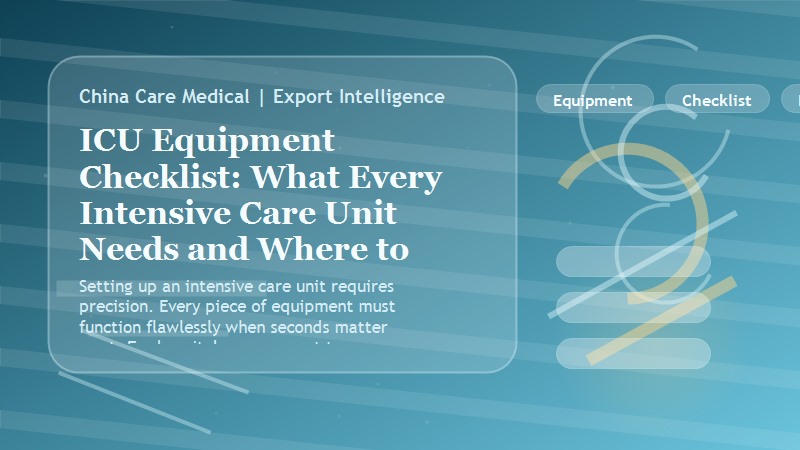
Liste de contrôle de l'équipement de soins intensifs : ce dont chaque unité de soins intensifs a besoin et où l'obtenir
The Critical Foundation of Life-Saving Care

Setting up an intensive care unit requires precision. Every piece of equipment must function flawlessly when seconds matter most. For hospital procurement teams planning new ICU facilities or upgrading existing units, having a comprehensive equipment checklist prevents costly oversights and ensures patient safety from day one.
This guide covers the essential equipment categories every ICU needs, along with practical sourcing considerations for procurement teams working with budget constraints. Whether you're equipping a 10-bed ICU or expanding to 50 beds, these fundamentals remain consistent across all intensive care environments.
Essential Patient Monitoring Systems
Multi-Parameter Patient Monitors
Every ICU bed requires continuous monitoring capabilities. Multi-parameter monitors track vital signs including ECG, blood pressure, oxygen saturation, temperature, and respiratory rate.
Key specifications to consider:
- 12-lead ECG capability
- Invasive and non-invasive blood pressure monitoring
- Arrhythmia detection and alarm systems
- Central station connectivity for remote monitoring
- Battery backup for patient transport
Brands like Mindray and Edan offer reliable monitoring solutions that meet international standards while providing cost-effective alternatives to premium European manufacturers. These systems integrate seamlessly with hospital information systems and provide the clinical accuracy ICU teams depend on.
Central Monitoring Stations
A central monitoring station allows nursing staff to observe multiple patients simultaneously. Modern systems support 16-32 bed monitoring with customizable alarm protocols and trend analysis.
Essential features:
- Real-time waveform display for all connected patients
- Alarm prioritization and escalation protocols
- Historical data storage and retrieval
- Integration with electronic medical records
- Backup monitoring capabilities
Life Support Equipment
Mechanical Ventilators
Ventilators represent the most critical ICU investment. Modern ICU ventilators must support both invasive and non-invasive ventilation modes for patients with varying respiratory needs.
Required ventilation modes:
- Volume control ventilation (VCV)
- Pressure control ventilation (PCV)
- Synchronized intermittent mandatory ventilation (SIMV)
- Pressure support ventilation (PSV)
- Continuous positive airway pressure (CPAP)
- Bilevel positive airway pressure (BiPAP)
Chinese manufacturers like Mindray have developed sophisticated ventilators that compete directly with established brands. Their systems include advanced lung protection protocols, integrated monitoring, and user-friendly interfaces that reduce training time for clinical staff.
Infusion Pumps and Syringe Pumps
Precise medication delivery is non-negotiable in ICU environments. Each bed typically requires 2-4 infusion channels for different medications and fluids.
Critical pump features:
- Drug library with dose error reduction software
- Multiple infusion profiles for different patient populations
- Wireless connectivity for central monitoring
- Battery life exceeding 4 hours
- Easy-to-clean surfaces for infection control
Volumetric infusion pumps handle larger fluid volumes, while syringe pumps provide precise delivery of high-concentration medications like vasopressors and sedatives.
Emergency Response Equipment

Defibrillators and Emergency Carts
Every ICU requires immediate access to defibrillation and emergency medications. Crash carts should be strategically positioned to reach any bed within 60 seconds.
Defibrillator specifications:
- Biphasic waveform technology
- Manual and automated external defibrillator (AED) modes
- Synchronized cardioversion capability
- Pacing functionality
- Data recording and event documentation
Crash cart essentials:
- Emergency medications (epinephrine, atropine, amiodarone)
- Airway management supplies
- Vascular access equipment
- Resuscitation documentation forms
Airway Management Equipment
Intubation and airway management equipment must be readily available for emergency situations and planned procedures.
Required airway equipment:
- Video laryngoscopes with multiple blade sizes
- Endotracheal tubes (sizes 6.0-9.0mm)
- Laryngeal mask airways
- Surgical airway kits
- Bag-mask ventilation systems
- Suction units with backup power
Specialized ICU Equipment
Dialysis and Hemofiltration Systems
Many ICU patients require renal replacement therapy. Continuous renal replacement therapy (CRRT) machines provide gentle, continuous treatment for critically ill patients.
CRRT system requirements:
- Multiple therapy modes (hemofiltration, hemodialysis, hemodiafiltration)
- Precise fluid balance monitoring
- Anticoagulation management systems
- Alarm systems for circuit integrity
- Easy-to-use interface for nursing staff
Point-of-Care Testing Equipment
Rapid diagnostic capabilities reduce treatment delays and improve patient outcomes. Essential point-of-care testing includes blood gas analysis, electrolyte measurement, and coagulation studies.
Key testing capabilities:
- Arterial blood gas analysis
- Basic metabolic panel
- Lactate measurement
- Hemoglobin and hematocrit
- International normalized ratio (INR)
Support Equipment and Infrastructure
Patient Beds and Positioning
ICU beds must accommodate complex patient positioning, equipment integration, and emergency access requirements.
ICU bed specifications:
- Electric height adjustment
- Trendelenburg and reverse Trendelenburg positioning
- Cardiac chair position capability
- Integrated scale systems
- Equipment mounting points
- Easy-to-clean surfaces
Environmental Control Systems
Maintaining appropriate environmental conditions supports patient recovery and infection prevention.
Environmental requirements:
- Temperature control (20-24°C)
- Humidity management (30-60%)
- Air filtration systems
- Positive pressure ventilation
- Noise reduction measures
Sourcing Considerations for 2026
Verified Manufacturer Partnerships
Working with established Chinese manufacturers provides access to advanced medical technology at competitive price points. Companies like Mindray, Edan, and Sonoscape have built strong reputations in international markets through consistent quality and reliable support.
Regulatory Compliance
Ensure all equipment meets relevant regulatory standards for your region:
- CE marking for European markets
- FDA approval for US installations
- ISO 13485 quality management certification
- IEC 60601 electrical safety standards
Training and Support Requirements
Factor training costs and ongoing support into procurement decisions. Reliable suppliers provide:
- On-site installation and commissioning
- Clinical training for nursing and respiratory therapy staff
- Technical training for biomedical engineering teams
- 24/7 technical support hotlines
- Preventive maintenance programs
Total Cost of Ownership
Consider long-term costs beyond initial equipment purchase:
- Consumables and replacement parts availability
- Service contract pricing
- Equipment lifecycle and upgrade paths
- Energy consumption and operational costs
Budget Planning Framework
Tier 1 Priority Equipment (60% of budget)
- Patient monitors and central stations
- Mechanical ventilators
- Infusion pump systems
- Defibrillators and emergency equipment
Tier 2 Supporting Equipment (25% of budget)
- Specialized therapy equipment (CRRT, ECMO)
- Point-of-care testing systems
- Advanced airway management tools
- Patient transport equipment
Tier 3 Infrastructure and Accessories (15% of budget)
- Furniture and patient positioning equipment
- Environmental monitoring systems
- Communication and documentation systems
- Storage and organization solutions
Implementation Timeline
Phase 1: Core Life Support (Months 1-2)
Install and commission essential monitoring, ventilation, and infusion systems. Complete staff training on primary equipment.
Phase 2: Specialized Equipment (Months 2-3)
Add dialysis systems, advanced monitoring capabilities, and specialized therapeutic equipment.
Phase 3: Optimization and Integration (Months 3-4)
Fine-tune system integration, complete advanced training programs, and establish maintenance protocols.
Quality Assurance and Validation
Pre-Installation Testing
- Factory acceptance testing for critical equipment
- Shipping and handling verification
- Documentation review and compliance checking
Commissioning Process
- Installation qualification (IQ)
- Operational qualification (OQ)
- Performance qualification (PQ)
- Clinical acceptance testing
Ongoing Quality Management
- Preventive maintenance scheduling
- Performance monitoring and trending
- Staff competency validation
- Equipment lifecycle planning
Conclusion
Equipping an ICU requires careful planning, substantial investment, and reliable supplier partnerships. This comprehensive checklist ensures your procurement team addresses all essential equipment categories while maintaining focus on patient safety and clinical effectiveness.
Success depends on balancing immediate needs with long-term operational requirements. Working with verified manufacturers who understand international healthcare standards reduces procurement risk while providing access to advanced medical technology.
For procurement teams ready to move forward with ICU equipment sourcing, partnering with experienced suppliers streamlines the complex process of international medical equipment procurement. Professional guidance helps navigate regulatory requirements, optimize equipment selection, and ensure successful project delivery.
Ready to equip your ICU with reliable, cost-effective medical equipment? Learn more at chinacaremedical.com and connect with our procurement specialists for personalized equipment recommendations and project planning support.
Related articles