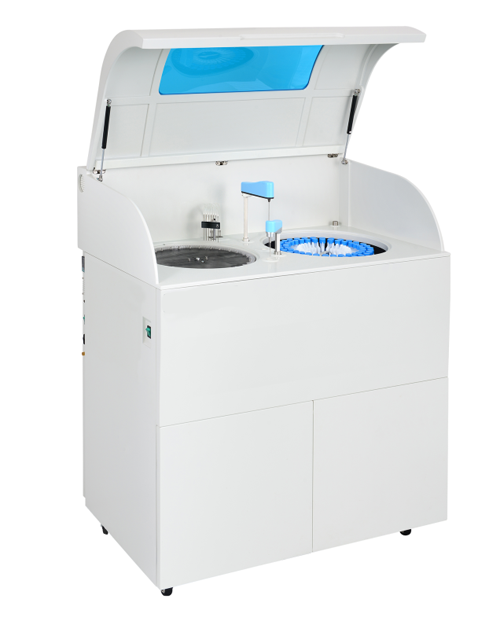
Product info
- Product name:320 Tests/Hour Fully Automated Clinical Chemistry Analyzer with Refrigerated Reagent Freezer System
- Product code:CCL320
Packaging Specifications
- Outer Packaging Size:1.1 × 0.65 × 1.28 m
- Gross Weight:160 kg
- Net Weight:155 kg
- Volume:0.92
Description
320 Tests/Hour Fully Automated Clinical Chemistry Analyzer
Product Introduction
The 320 tests/hour fully automated clinical chemistry analyzer is a high-performance in-vitro diagnostic system designed for routine and specialized biochemical testing in hospital laboratories and diagnostic centers.
It integrates advanced optical photometric technology, intelligent sample handling, and a refrigerated reagent compartment (“freezer function”) to ensure stable reagent performance and continuous 24-hour operation capability.
Key Advantages
High Throughput 320 Tests/Hour
Supports up to 320 photometric tests per hour, making it suitable for medium to large hospital laboratories with high daily sample volumes.
Refrigerated Reagent “Freezer Function”
Built-in reagent cooling system maintains stable low temperature (typically 2–8°C), ensuring reagent activity, reducing degradation, and enabling continuous long-cycle operation.
Fully Automated Workflow
Automated processes include:
- Sample loading
- Reagent dispensing
- Reaction mixing
- Optical detection
- Result calculation
- Report output
Minimizing manual intervention and human error.
High Accuracy Photometric System
Advanced optical detection ensures reliable measurement of biochemical reactions with stable absorbance reading and low carry-over rate.
Open System Compatibility
Supports a wide range of clinical reagents, offering flexibility for different laboratory protocols and reducing long-term operational costs.
STAT Priority Function
Emergency samples (STAT) can be prioritized at any time, ensuring rapid turnaround for critical patients in emergency and ICU departments.
Clinical Applications
The system is widely used for routine and specialized biochemical testing, including:
- Liver function tests (ALT, AST, ALP, TBIL)
- Kidney function tests (UREA, CREA)
- Lipid profile (CHOL, TG, HDL, LDL)
- Blood glucose testing
- Electrolyte analysis (Na, K, Cl, Ca)
- Enzyme assays
- Cardiac-related biochemical markers
- General hospital biochemistry panels
Technical Overview
| Item | Specification |
|---|---|
| Type | Fully Automated Clinical Chemistry Analyzer |
| Throughput | Up to 320 tests/hour |
| System | Random access, continuous loading |
| Reaction Method | Photometric / Colorimetric analysis |
| Sample Handling | Automatic sampling & dilution |
| Reagent System | Open system supported |
| Reagent Storage | Refrigerated compartment (freezer function) |
| STAT Function | Supported (priority testing) |
| Calibration | Multi-point automatic calibration |
| QC System | Levey-Jennings / Westgard rules |
| Data System | LIS/HIS connectivity supported |
| Display | Built-in computer system / external PC |
Why Refrigerated Reagent System Matters
In clinical chemistry testing, reagent stability directly affects accuracy.
The freezer function provides:
- Stable enzyme activity
- Reduced reagent waste
- Longer onboard reagent life
- Fewer calibration interruptions
- Better result consistency
- This is especially important for hospitals running 24/7 emergency testing.
Why Hospitals Choose This Analyzer
Compared with low-end semi-automatic systems, this model provides:
- Higher automation level
- Faster sample throughput
- Reduced labor dependency
- Better consistency in large sample batches
- Improved emergency response (STAT mode)
- Lower long-term cost per test
- It is ideal for laboratories transitioning from semi-automated to fully automated workflows.
Recommended Users
- Hospital clinical laboratories
- Diagnostic centers
- Medical laboratories with medium-high workload
- Government hospital procurement projects
- Private hospitals and health screening centers
- Regional laboratory networks
System Configuration
Typical system includes:
- Main analyzer unit
- Sample rack system
- Reagent refrigerated module
- Reaction cuvette system
- Optical detection module
- Software system (LIS integration optional)
- Waste management system
no comments