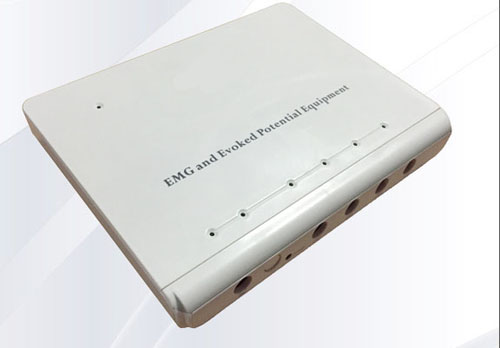
Product info
- Product name:2 & 4 Channel EMG Electromyography System – Neurology Diagnostic EMG/EP/NCV Machine
- Product code:CCE-GC1
Packaging Specifications
- Outer Packaging Size:0.55 × 0.41 × 0.31 m
- Gross Weight:7 kg
- Net Weight:5 kg
- Volume:0.07
- Outer Packaging Size:0.6 × 0.12 × 0.42 m
- Gross Weight:0.48 kg
- Net Weight:3.13 kg
- Volume:0.03
- Outer Packaging Size:0.4 × 0.24 × 0.53 m
- Gross Weight:6.65 kg
- Net Weight:5.65 kg
- Volume:0.05
- Outer Packaging Size:0.34 × 0.24 × 0.2 m
- Gross Weight:5 kg
- Net Weight:4 kg
- Volume:0.02
- Outer Packaging Size:0.48 × 0.24 × 0.16 m
- Gross Weight:5 kg
- Net Weight:4 kg
- Volume:0.02
- Outer Packaging Size:0.45 × 0.7 × 0.31 m
- Gross Weight:4 kg
- Net Weight:3 kg
- Volume:0.1
- Outer Packaging Size:0.72 × 0.78 × 1 m
- Gross Weight:86 kg
- Net Weight:70 kg
- Volume:0.56
Description
2 & 4 Channel EMG Electromyography System
Product Introduction
The 2 and 4 channel EMG electromyography system is a professional neurophysiology diagnostic device used to record and analyze the electrical activity of muscles and peripheral nerves.
It is widely used in neurology departments, rehabilitation centers, orthopedic clinics, and clinical neurophysiology laboratories for comprehensive nerve and muscle function assessment.
The system supports EMG (electromyography), NCS/NCV (nerve conduction studies), and evoked potential (EP) examinations, providing a complete neurological diagnostic solution.
Key Advantages
Multi-Channel Flexible Configuration (2 / 4 Channels)
Supports both 2-channel and 4-channel operation modes, allowing flexible configuration based on clinical workload and diagnostic needs.
Comprehensive Neurophysiological Testing Platform
Supports a full range of neurological examinations:
- EMG (Electromyography)
- NCV / NCS (Nerve Conduction Velocity / Study)
- F-wave analysis
- H-reflex testing
- RNS (Repetitive Nerve Stimulation)
- Blink Reflex
- SEP (Somatosensory Evoked Potentials)
- VEP (Visual Evoked Potentials)
- BAEP (Brainstem Auditory Evoked Potentials)
High-Precision Signal Acquisition System
Advanced amplifier system ensures:
- Low noise signal capture
- High CMRR (anti-interference performance)
- High-resolution A/D conversion
- Stable waveform acquisition
This ensures accurate clinical interpretation of neuromuscular activity.
Intelligent Software Analysis System
Integrated software provides:
- Automatic waveform analysis
- Neuro-mapping visualization
- Muscle function navigation
- Standard reference comparison
- Multi-waveform storage and replay
- Report generation system
Real-Time Multi-Channel Synchronization
Supports simultaneous acquisition of up to 4 channels for complex neurological assessments.
Flexible System Integration
Supports USB connection to PC-based systems with adaptable display resolution and Windows compatibility for clinical environments.
Clinical Applications
The EMG/EP system is widely used in:
- Neurology departments
- Rehabilitation medicine centers
- Orthopedic clinics
- Neurosurgery pre-operative evaluation
- Peripheral nerve injury diagnosis
- Spinal cord disorder assessment
- Muscle disease diagnosis (myopathy, neuropathy)
- Stroke rehabilitation evaluation
- Electrophysiology research laboratories
Technical Specifications
表格
| Item | Specification |
|---|---|
| Channels | 2 / 4 selectable |
| System Type | EMG / EP / NCV diagnostic system |
| A/D Conversion | 24-bit high resolution |
| Sampling Rate | Up to 200 kHz |
| Bandwidth | 1 Hz – 5 kHz |
| Noise Level | ≤ 0.4 μV |
| CMRR | ≥ 110 dB |
| Input Impedance | >1000 MΩ |
| Stimulus Frequency | 0.1 – 50 Hz |
| Analysis Time | 1 – 1000 ms |
| Interface | USB / PC-based system |
| Software | EMG analysis & reporting system |
What This System Measures
EMG (Muscle Activity)
- Motor unit potentials
- Interference patterns
- Muscle recruitment analysis
Nerve Conduction Studies (NCV/NCS)
- Motor conduction velocity
- Sensory conduction velocity
- Latency & amplitude analysis
Evoked Potentials (EP)
- VEP (visual pathway)
- BAEP (auditory brainstem)
- SEP (somatosensory pathway)
Why Hospitals Use EMG Systems
Compared with basic neurological testing, EMG/EP systems provide:
- Objective nerve and muscle function measurement
- Early diagnosis of neuropathy and myopathy
- Accurate lesion localization
- Quantitative neurophysiological data
- Comprehensive functional assessment
- It is a standard diagnostic tool in modern neurology departments.
Recommended Users
- Hospital neurology departments
- Rehabilitation centers
- Orthopedic clinics
- Neuroscience research institutions
- Medical teaching hospitals
- Diagnostic laboratories
- Medical equipment distributors
System Configuration
Typical system includes:
- EMG main unit (2/4 channel amplifier)
- Stimulation module
- Electrode sets
- Signal acquisition system
- PC software platform
- Optional accessories (stimulators, trolley, printer, monitor)
no comments